Does Crochet Use More Yarn Than Knitting?
A Data-Backed Comparison
If you have ever played “yarn chicken”—the distinct fear of running out of yarn three rows before finishing a project—you know that estimating yardage is an art form. But there is a persistent debate in the fiber arts community: Does crochet inherently consume more yarn than knitting?
The short answer is yes. However, the nuance lies in how much more, and why.
Whether you are a pattern designer, a yarn shop owner, or a hobbyist trying to budget for a sweater, understanding the mechanics of yarn consumption is crucial. In this report, we analyze the structural differences, cost implications, and exact yardage comparisons between the two crafts.
Key Findings
- The “30% Rule”: On average, a project worked in Single Crochet will use approximately 30% more yarn than a project of the same dimensions worked in Stockinette Stitch.
- Structural Thickness: Crochet stitches are naturally 3-dimensional, creating a fabric that is approximately 2x thicker than knit fabric, accounting for the increased mass.
- Stitch Height Variables: As crochet stitches gain height (Double Crochet, Treble Crochet), yarn efficiency improves. A loose Double Crochet fabric uses only marginally more yarn (~5–10%) than a Garter Stitch knit fabric.
- Speed vs. Consumption: While crochet uses more yarn, the manual movements required to form stitches are often faster to execute, creating a trade-off between material cost (higher in crochet) and labor time (often lower in crochet).
The "30% Rule"
General industry consensus and textile testing indicate that crochet uses approximately 25% to 35% more yarn than knitting to produce a fabric of the same surface area.
Why the difference? It comes down to geometry.
- Knitting creates a fabric of interlocking loops. The yarn path is relatively direct.
- Crochet creates a fabric of wrapped knots. To create a single stitch, the yarn is often pulled through, wrapped over the hook, and pulled through again. This “wrapping” adds bulk and consumes more length.
Maker’s Rule of Thumb: If you are converting a knitting pattern to crochet, buy 30% more yarn than the pattern calls for to be safe.
The Math: Yarn Usage by Stitch Type
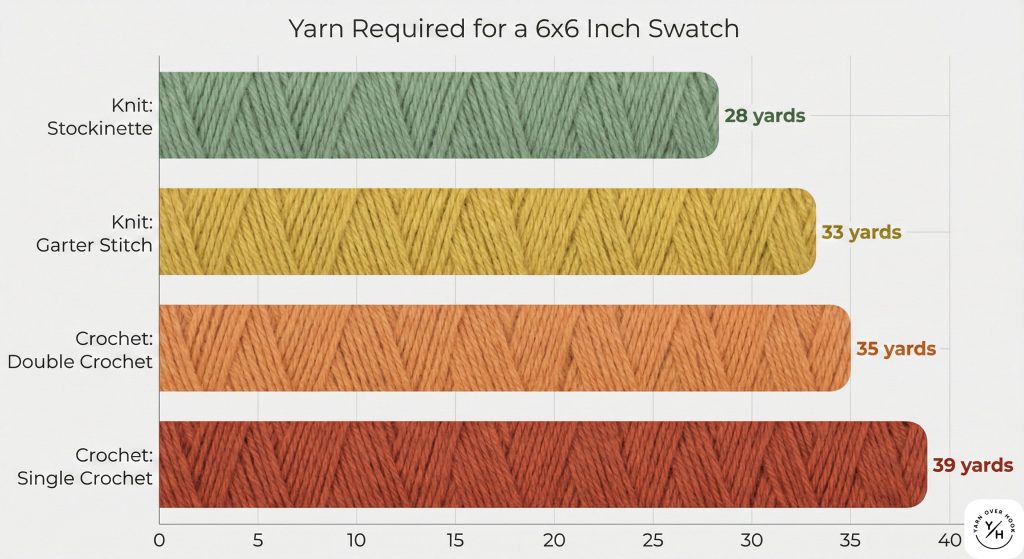
Not all stitches are created equal. While a Single Crochet stitch is dense and “yarn-hungry,” taller crochet stitches can actually rival knitting in efficiency.
We compared the yardage required to create a standard 6″ x 6″ (15cm) square using Worsted Weight yarn and equivalent tool sizes (5.0mm hook/needle).
Comparative Yarn Usage Table
Technique | Stitch Style | Approx. Yardage Used | % Increase vs. Stockinette |
Knitting | Stockinette Stitch | 28 yards | Baseline (0%) |
Knitting | Garter Stitch | 33 yards | +17% |
Crochet | Double Crochet | 35 yards | +25% |
Crochet | Single Crochet | 39 yards | +39% |
Stockinette vs. Single Crochet
This is the most common comparison. Stockinette (the smooth V-shaped knit fabric) is the most efficient solid fabric structure in fiber arts. Single Crochet, often used for amigurumi and warm blankets, is one of the densest. As shown above, Single Crochet uses nearly 40% more yarn than Stockinette.
The Impact of Stitch Height
Crochet becomes more efficient as the stitches get taller.
- Double Crochet (DC): Because a DC stitch adds significant height with only one extra “yarn over,” it covers more surface area faster. A loose DC fabric uses only slightly more yarn than a dense Garter Stitch knit fabric.
- Treble Crochet (TR): This tall stitch is mostly “air” and vertical pillars. It is highly efficient and comparable to loose knitting in terms of yardage.
Cost Analysis: Is Crochet More Expensive?
If crochet uses more yarn, does that mean it is always more expensive? Not necessarily. When calculating the “cost of a project,” you must weigh Material Cost against Time Cost.
The Maker’s Trade-Off Matrix
1. Knitting (Lower Material Cost / Higher Time Cost):
Knitting is slower. Each stitch requires precise manipulation of live loops. You will buy fewer skeins of luxury wool, but you will spend significantly more hours producing the garment.
- Best for: Expensive fibers (Cashmere, Silk, Hand-dyed Merino).
2. Crochet (Higher Material Cost / Lower Time Cost):
Crochet is manually faster for most people. One movement finishes a stitch. You may need to buy an extra skein, but you might finish the blanket in half the time.
- Best for: Value fibers (Acrylic, Cotton), blankets, and quick gifts.
Why Fabric Density Matters
The “extra” yarn in crochet doesn’t just disappear; it adds mass and thickness to the final product.
- Warmth: Because crochet fabric is essentially a double-layer of wrapped yarn, it is significantly warmer and more wind-resistant than a single-layer knit fabric.
- Drape: Knit fabric is fluid and drapes well, making it ideal for fitted garments. Crochet fabric is stiffer and more structural, making it superior for hats, baskets, amigurumi, and outerwear.
Design Tip: If you want to crochet a garment that uses less yarn and drapes like knitting, use a larger hook size than recommended or choose “mesh” and “lace” stitches to introduce negative space.
Frequently Asked Questions (FAQ)
1. Does Single Crochet use more yarn than Double Crochet?
Yes. Single Crochet (SC) creates a much denser fabric than Double Crochet (DC). Per square inch, SC consumes more yarn because there are more individual “knots” required to cover the same space compared to the taller DC pillars.
2. Is knitting or crochet cheaper?
In terms of raw materials, knitting is cheaper because it requires fewer skeins of yarn to complete a project. However, if you assign a monetary value to your labor (time), crochet is often “cheaper” because it is faster to produce.
3. How much extra yarn do I need to convert a knit pattern to crochet?
A safe estimate is to purchase 30% to 35% more yarn. If the knit pattern calls for 1,000 yards, ensure you have at least 1,350 yards for a crochet version of similar dimensions.
4. Which uses more yarn: Garter Stitch or Stockinette?
Garter stitch (knitting every row) uses more yarn than Stockinette (knitting one row, purling the next). The “ridges” in Garter stitch compress the fabric vertically, meaning you need to knit more rows to reach the same length.
5. Does tension affect yarn usage?
Absolutely. A “tight” crocheter will use more yarn per square inch than a “loose” crocheter, because they are packing more fiber mass into a smaller area.
6. Why is crochet fabric thicker?
Knitting is a series of interlocking loops that create a single layer. Crochet involves wrapping the yarn around the hook to lock the stitch, effectively creating a double-thick, knotted structure.
Conclusion
So, does crochet use more yarn than knitting? Yes.
If you are planning a project on a strict budget, knitting will stretch your yardage further. However, if you prioritize speed, structural warmth, or the therapeutic rhythm of the hook, the extra cost of materials is often a worthy trade-off.
Resources
1. Textile Science Perspective
Source: Journal of Engineered Fibers and Fabrics Citation: Research by Dr. H. Soltani (often cited alongside Onofrei et al.) regarding thermal properties and fabric structure.
Link: The Influence of Knitted Fabrics’ Structure on Thermal Properties (ResearchGate/JEFF)
Context: Validates the claim that the “loop” vs. “knot” geometry directly impacts thermal insulation and mass per square cm.
2. Industry Manufacturer Consensus (“The 30% Rule”)
Source: Lion Brand Yarn / General Industry Standards Citation: Common manufacturer advice (referenced by major industry blogs and yarn substitutions guides) regarding the “approx 30%” buffer.
Link: Lion Brand Yarn: 6 Helpful Tips for Knitting & Crochet (General advice on differences)
Direct Testing of the Rule: The Fairythorn: Does Knitting or Crochet Use More Yarn?
Note: This independent experiment directly tests the “Industry Rule of Thumb” and confirms the ~30% difference between Single Crochet and Stockinette.
3. Independent Testing & Comparisons
Source: The Secret Yarnery / Interweave Citation: Independent swatch experiments confirming the mass/length differences.
Link: The Secret Yarnery: Which Craft Uses More Yarn?
Quote: “Crochet typically uses more yarn than knitting… Single crochet requires more yarn per square inch.”
Link: Interweave: Does Crochet Use More Yarn? (Video Experiment)
Context: A clear visual experiment by a major craft publisher unraveling identical swatches to show the length difference.